
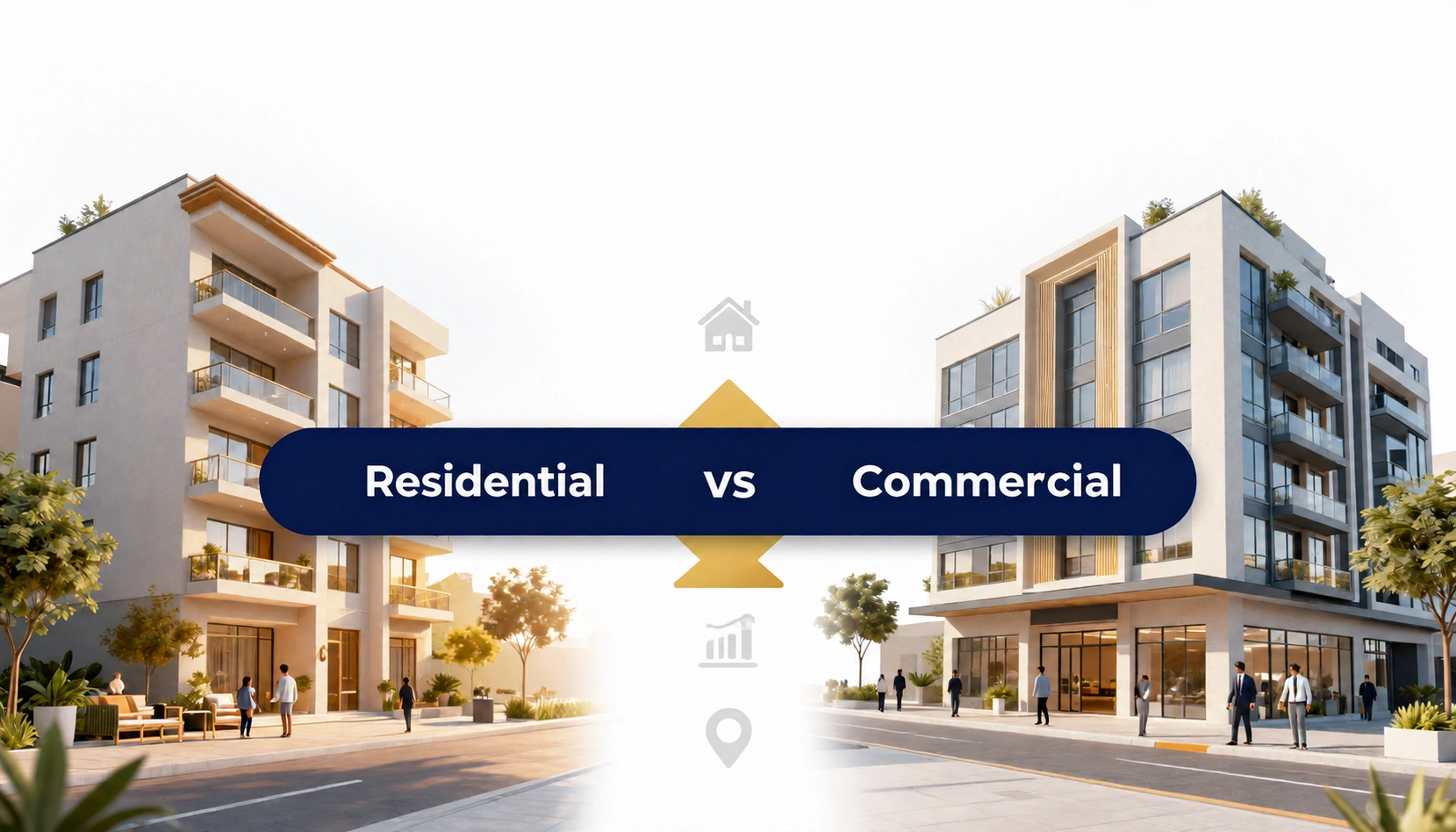
Short Answer: Which Is Better for Investment, Residential or Commercial Property?
Residential property often suits investors seeking a broader demand base, simpler management, and greater flexibility in use or resale. Commercial property may suit those targeting higher potential rental income and who can accept greater operational risk, longer vacancy periods, and higher fit-out costs. The better choice is the one that delivers an acceptable net return after all costs and matches your budget, investment horizon, management capacity, and exit plan.
What is the difference between residential real estate and commercial real estate
The difference starts from the basic purpose of the unit. The residential property is intended for the residence of individuals and families, such as apartments, villas and coastal units. Commercial real estate is used to operate an activity or provide a service, such as shops, offices, clinics, service centers, administrative and medical units.
Residential property
The demand for residential real estate depends mainly on the need for housing, proximity to schools, services, roads and facilities, the quality of the area and finishing, the suitability of the space and the price for the target families or individuals.
Commercial real estate
The demand for commercial real estate depends on the movement of economic activity, the size of the audience, companies or patients, the clarity of the frontage, accessibility, entrances and parking, the type of permitted activity, the operating power of the project and the surrounding area.
For more detailed information about shops, offices and clinics, you can check the guide Investing in commercial real estate.
Comprehensive comparison between residential and commercial real estate
| Comparison Factor | Residential property | Commercial real estate |
|---|---|---|
| Nature of use | Accommodation and living for individuals and families. | The operation of a commercial, administrative or medical activity. |
| Source of Demand | The constant need for housing and daily services. | The movement of customers, companies and the need of the market for activity. |
| The segment of tenants | Individuals and families, which is a relatively wider segment. | Companies, doctors, business owners and service providers. |
| Rental Yield | It may be more stable and less volatile in the required areas. | It may be higher, but it is more sensitive to location, operation and vacancy. |
| Management | Relatively simpler for a novice investor. | You need to keep track of the activity, contract, fit-out and expenses. |
| Period of vacancy | They may be shorter in residential areas with real demand. | It may be prolonged if the activity is limited or the location is weak. |
| Lease term | It is often shorter and varies according to the tenant’s needs. | It may be longer when the tenant is an established company or business. |
| Fit-out Cost | Finishing, furnishing and maintenance according to the market level. | They may be higher due to the nature of the activity, frontage and fittings. |
| Resale Potential | The buyer base may be wider at the desired sites. | They depend on the specialization of the unit, the strength of the site and the expected income. |
| Risks | Relatively less complicated, with price, location and vacancy risks remaining. | More sensitive to activity, market, competition and operation. |
| Flexibility | It may combine personal housing, rental and resale. | It is often associated with a specific use or activity. |
| The right investor | Who prefers stability, simpler management and long-term retention. | Who is targeting a higher income and accepts more complex analysis and management. |
Important: The previous comparison is general and does not mean that every residential unit is less profitable or that every commercial unit provides a higher return. An apartment in a strong location may outperform a shop in a low-footfall corridor, while a well-occupied clinic may outperform an overpriced residential unit.
When is residential real estate better to invest
When searching for a wide demand segment
The residential property serves a basic need, therefore the base of tenants and buyers is relatively wider in areas with services, roads, facilities and a suitable living environment.
When simpler management is preferred
Renting an apartment usually needs less complicated management than running a shop or clinic. However, the tenant, contract, maintenance, vacancy period should be reviewed and occupancy should not be assumed throughout the year.
When there is an average budget
Residential units are often available in a variety of sizes, prices and payment plans, which gives the investor a wider choice. And you should always compare the final price, finishing and expenses, not just the value of the down payment.
When planning long-term retention
The residential may suit those who aim to keep the unit, take advantage of the rent and the growth of the area over time, provided that the unit is purchased at a reasonable price and in a location that has real demand.
When you want to combine use and investment
The buyer can use the unit for future housing, rent it out or resell it, which gives him flexibility that may not be available in a commercial unit dedicated to a specific activity.
When better relative liquidity is needed
In some markets, the buyer base for residential units is wider than for specialized retail units, which may help with resale, but this remains related to price, space, location and market condition.
When is commercial real estate more convenient
When the unit is in a clear and accessible location
Shops, offices, clinics need a location that corresponds to the nature of the activity. The facade, entrances, parking, footfall, proximity to residential or administrative areas are all factors affecting the rental opportunities.
When there is an actual demand for activity
It is not enough to have the unit inside a modern project. The required activities, the number of competitors, the percentage of operation, the size of the target audience, the suitability of space, floor and equipment for the activity should be studied.
When the unit is flexible to use
A unit that fits more than one permitted activity may have a wider tenant base than a highly specialized unit, provided that the activities comply with regulations and the project design.
When there is a long contract and a stable tenant
Longer commercial leases may provide greater income stability, but you should review annual rent increases, payment dates, guarantees, maintenance responsibilities, fit-out obligations, and termination or vacating terms.
When You Can Manage Operating Costs and Expenses
A commercial property investor may incur higher maintenance, management, fit-out, and marketing costs and must monitor the performance of the project, tenant, and business activity more closely.
When calculating the net return realistically
A shop or office should not be evaluated solely by gross rent. Maintenance, management, vacancy, fit-out and fees should be deducted, and then compare the net income with the total invested funds.
Net return = annual net income ÷ total investment cost × 100
The manual can be reviewed Return from commercial real estate To find out the calculation method in detail.
Comparing the return and risk between residential and commercial
Commercial real estate may bring a higher percentage of income in some cases, but a higher percentage does not necessarily mean that the investment is better. The net return should be considered after expenses and vacancies, how stable the income is, ease of management, the investor's ability to withstand delays or low occupancy.
| Item | Hypothetical Residential Unit | Hypothetical Commercial Unit |
|---|---|---|
| Total investment | 2,500,000 EGP | 3,500,000 EGP |
| Annual net income | 175,000 EGP | 315,000 EGP |
| Approximate net return | 7% | 9% |
| Expected vacancy | It may be shorter in a desired residential area. | It may be prolonged if there is no suitable tenant for the activity. |
| Management | Relatively simpler. | It requires closer monitoring of the tenant, business activity, and project operations. |
| Fit-out | Finishing, furnishing and maintenance. | It may require specialized and expensive equipment. |
| Proper selection | For those who prefer stability and simpler management. | For those who accept greater risk and management in exchange for a higher potential income. |
The example is educational and does not represent an actual return or price for any project. The yield of a commercial unit may decrease if the vacancy period or the cost of fit-out increases, while the residential yield may decrease if the purchase price is high or the supply is large.
How to choose between residential and commercial real estate
1. Set your goal
Do you want housing, rental income, a place for your business, long-term holding, or resale? Your goal determines the unit type, location, investment period, and acceptable level of risk.
2. Calculate the full budget
Add up the final purchase price, finishing, fit-out, maintenance, fees, financing and reserve, do not use the down payment as the cost of the investment.
3. Estimated net return
Use realistic rents for similar units, deducting expenses and vacancies. If the unit is under construction, enter the waiting period before leasing in the account.
4. Compare the level of risk
Consider the possibility of lower rent, delayed handover, higher finishing costs, a longer vacancy period, and difficulty selling. Investor.gov explains that higher potential returns are generally associated with greater risk and uncertainty.
5. Check the site and comparisons
The RICS guidelines recommend using suitable comparison properties taking into account the differences between location, area, finishing, use and delivery, and not relying on a single advertisement.
6. Assess the Ease of Exit
Check the terms of the assignment, its fee, the segment of potential buyers, how specialized the unit is, how long the sale may take.
7. Review the contract and documents
Check the type of use, unit specifications, delivery, maintenance, management, permitted activities, rental and resale conditions, hire a specialist when needed.
The Role of Location in the Success of Residential and Commercial Investment
The criteria for a good location vary depending on the type of property. Residential needs a suitable living environment, services, roads, schools and facilities, while commercial needs visibility, movement, access, parking and a real demand for activity.
Residential location factors
- Proximity to daily services, schools and roads.
- The quality of the streets, tranquility and safety.
- Availability of facilities and maintenance.
- Suitable space for the capacity of target families.
- The volume of supply and competition within the region.
Commercial location factors
- Facade and view from the street or corridor.
- Easy access, entrances and parking.
- Population, administrative or medical density.
- Suitability of the activity for the public and the region.
- The operating strength and tenant mix within the project.
The adjective "developing city" or "integrated project" is not enough to judge investment; the specific location, the actual unit, demand, services and competition must be examined.
Examples of residential and commercial opportunities in mahawer projects
Exposure Mahawer Developments Projects Residential, commercial, administrative and medical units within New Damietta. The following examples are cited for clarification, and do not represent a recommendation or a guarantee of return.
Sea Dar Compound
Sea Dar Compound is a residential project that may suit buyers seeking a home or a long-term investment. Compare the unit size, location within the project, price, payment plan, and handover date.
SIAG Residence
SIAG Residence includes residential projects and phases in New Damietta. Each phase can be compared based on its location, unit size, construction progress, and budget.
Tuvalu Mall
Tuvalu Mall includes commercial, office, and medical units. Each unit should be evaluated according to its type, location within the project, size, total cost, and expected foot traffic.
The ONE by Mahawer
The ONE by Mahawer is a mixed-use project comprising residential, commercial, and office units, allowing buyers to compare different types of use within one location according to their goals and budgets.
Note: Prices, unit sizes, handover dates, and payment plans change over time. Always review the latest information and contract terms when making an inquiry.
Common mistakes when comparing residential and commercial
Choosing the highest declared return
A high yield may depend on an unrealistic rent or not include vacancy, fit-out and maintenance, or be the result of poor location and a low price due to risks.
Dependence on the value of the down payment
The down payment does not represent the total cost. The final price, finishing, fit-out, fees, installments and payments should be compared.
Assuming Commercial Property Is Always Profitable
A commercial unit may fail to rent due to poor activity, location or operation, while a good residential unit achieves a more stable occupancy.
The assumption that the Residential is risk-free
Housing may be affected by an overestimated price, poor services, oversupply, poor execution or inappropriate tenant selection.
Ignoring the fit-out cost
Some commercial units require substantial fit-out costs, while residential units may also need finishing, furnishing, and maintenance before they can be rented.
Lack of an exit plan
Before committing, determine how and when the property can be sold, identify the potential buyer pool, review the assignment terms, and assess the property’s liquidity.
Comparison of dissimilar units
Do not compare a ready-made unit with another under construction without calculating the wait, a shop with a main facade with an interior shop, or a fully finished apartment with a unit that needs equipment.
Quick decision table: which type is closer to your goal
| Your goal or situation | The closest option to study |
|---|---|
| A novice investor prefers simpler management | Residential property in a sought-after area. |
| Want housing now and rent in the future | A residential unit. |
| Have an activity and want a headquarters | A commercial, administrative or medical unit by activity. |
| Accept greater management and risk in exchange for higher potential income | Commercial property after market study and operation. |
| Your budget can't afford high fit-out | Compare a residential unit with a small business unit before deciding. |
| You need a wider buyer base when reselling | A residential unit with a required area and price in the market. |
| Looking for a longer contract with a professional tenant | An office, clinic or shop with a strong tenant and a clear contract. |
| Want to diversify the portfolio | Distribute the investment among more than one type if the budget allows. |
A checklist before choosing a residential or commercial property
- Specify the purchase goal and retention period.
- Calculate the final price, not just the down payment.
- Add finishing, fit-out, maintenance and fees.
- Compare actual or realistic rents for similar units.
- Calculate a possible vacancy period.
- Calculate the net return after expenses.
- Examine the location, access, services and traffic.
- Review the type of Use and permitted activities.
- Check the developer, project, contract and delivery.
- Review the terms of assignment and resale.
- Test a conservative scenario for rent and expenses.
- Select an exit plan before buying.
Article Methodology and Commercial Disclosure
This guide was prepared to clarify the practical differences between residential and commercial property investment based on use, demand, tenant profile, fit-out requirements, expenses, vacancy, net return, and liquidity. The comparison does not assume that either type is always better.
Commercial Disclosure: This article is published on the official website of Mahawer Real Estate Development and includes links to projects owned by the company. Project-related sections should be treated as informational and commercial content, compared with market alternatives, and checked against the latest information and contracts before making a decision.
Content Limitations: This article does not constitute financial, legal, or tax advice or an official valuation of any property. Outcomes vary according to the unit, location, cost, tenant, market, and contract. Consult independent specialists when necessary.
Sources and References
Conclusion: how to choose the most suitable type
The difference between residential and commercial property shows that each type serves a different purpose. Residential property meets the need for housing and generally offers a broader demand base, simpler management, and greater flexibility. Commercial property is linked to economic activity and may generate higher income when the location, operations, and tenant profile have been carefully assessed.
Do not base your decision only on the property type or advertised yield. Compare the total cost, net return, vacancy, fit-out requirements, ease of management, and resale potential. The best unit is the one that matches your budget, goals, and risk tolerance and remains viable under a conservative scenario.
You can use the Real Estate Consultant in New Damietta guide to compare available units and projects based on your needs and budget.
Frequently asked questions about residential and commercial real estate
Is residential real estate better than commercial for investment
Not always. Residential property may suit those who want a broader demand base and simpler management, while commercial property may suit those seeking higher income and who can assess the location, business activity, and expenses in greater depth.
Which brings a higher return: residential or commercial
A commercial property may generate a higher return in a strong location, but it may also involve longer vacancy periods, higher fit-out costs, and greater expenses. Therefore, compare the net return after deducting all costs.
Is residential real estate less risky
It is less complicated in many cases, but it is not risk-free. A high price, poor location or oversupply may reduce the yield.
Is commercial real estate harder to resell
It may be slower if the activity is limited or the unit is highly specialized, while a flexible unit with a clear income may attract investors and business owners better.
What expenses should be calculated
They include the final purchase price, finishing, fit-out, maintenance, management, commissions, financing, repairs, vacancy period and any fees charged by the owner.
Is the unit under construction suitable for investment
They may be suitable if the price, location and project are good, but they do not bring income before delivery, fit-out and leasing, so the waiting time and operational risks must be calculated.
What is best for a novice investor
Residential real estate in a sought-after area may be simpler to manage, but the decision should be based on budget, location, price, return and risk, and not experience alone.
How do I know if a business unit is suitable
A commercial unit may be suitable when there is real demand for the activity, the location is visible and accessible, the fit-out requirements and total cost are appropriate, and the net return remains realistic after deducting vacancy and expenses.
How do I know that the unit is suitable for long-term investment
When you combine a reasonable price with a site that has real demand, affordable costs and relative ease of leasing or resale, without relying on undocumented promises.
Can the return of the property be guaranteed
A stable return cannot be guaranteed; because the results are affected by the location, market, expenses, vacancy, tenant, project status, timing of purchase and sale.